
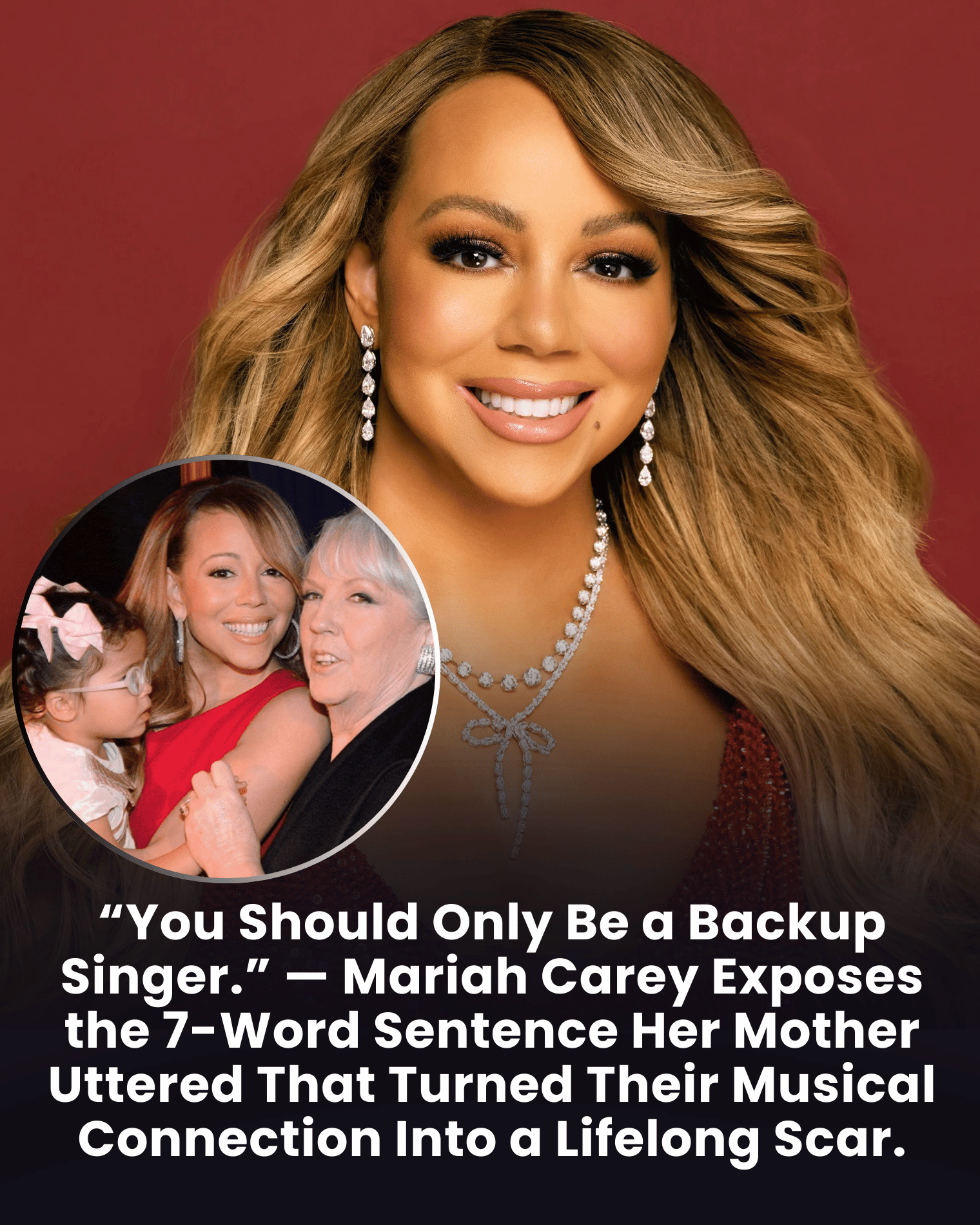
For much of her life, Mariah Carey has spoken about her voice as both a gift and a battlefield. It was nurtured at home, shaped by classical discipline, and sharpened by ambition. But it was also the source of one of her deepest emotional wounds.
Mariah's mother, Patricia Carey, was a trained opera singer with formal vocal technique and unfulfilled professional aspirations. From childhood, Mariah was immersed in scales, breath control, and phrasing. Patricia recognized her daughter's extraordinary range early, guiding her through exercises that most children would find intimidating.
On the surface, it was mentorship.
Underneath, it was complicated.
In interviews and memoir reflections, Mariah has described a pivotal moment during a casual practice session at home. She had just executed a difficult note with apparent ease—one that required both control and power. Instead of celebration, she sensed a shift in the room.
Her mother looked at her and reportedly delivered a sentence that would echo for decades: "You should only be a backup singer."
Seven words. Heavy as stone.
Mariah has recalled feeling a literal "thud" in her chest when she heard it. The comment wasn't framed as playful teasing. It carried a cold edge—one that suggested limitation rather than encouragement.
For a young artist discovering her identity through sound, that moment planted a seed of doubt. It also introduced something far more corrosive: competition.
Patricia had once chased a career that never fully materialized. Mariah's natural ability, coupled with commercial success, created an uncomfortable mirror. Instead of simply being mother and daughter, their relationship occasionally blurred into mentor and rival.
Mariah has spoken about the emotional tension that followed her rise to fame. As her albums sold in the millions and her five-octave range became legendary, the celebration was rarely uncomplicated at home. The woman who taught her to sing was also the woman who struggled with watching her surpass her.
The concept of "maternal competition" is rarely discussed openly, but Mariah has acknowledged its presence in her life. Success, rather than uniting them, sometimes deepened the divide.
And yet, the story is not entirely defined by resentment. Mariah has also credited her mother's classical training for giving her the technical foundation that allowed her to dominate pop and R&B charts. The irony is unavoidable: the same voice that caused friction was the one Patricia helped refine.
Over the years, they attempted to rebuild bridges. There were reconciliations, shared performances, moments of visible pride. But the scar remained—a reminder that even talent nurtured in love can become tangled in unfulfilled dreams.
For Mariah, the sentence became fuel. If she was told to stand in the background, she would stand center stage. If doubt hovered, she would out-sing it.
Today, her legacy is undeniable. But beneath the diamond records and whistle notes lies that early realization: sometimes the hardest critic is the one who first taught you how to breathe.
And sometimes, the echo of seven words can last a lifetime.